Progress through two centuries: a short history of the South Place Ethical Society.
The Society began as a dissident congregation in 1787 in rebellion against the doctrine of eternal hell. By 1793 it had its first premises in Bishopsgate. The next step was rejection of the Trinity – which lost the Society many of its members. It survived the loss, however, and has since survived many similar losses of membership following similar progressive steps on the road from universalism and unitarianism to the present humanist position, which it had reached by the end of the nineteenth century.
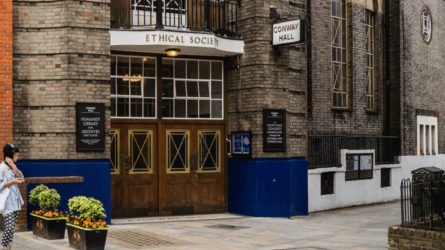
In 1817 William Johnson Fox became minister of the congregation which in 1824 built a new chapel in South Place. This the Society occupied for 102 years and the name is still commemorated in the title of the Society, although it moved from South Place in 1926 to build its present home in Red Lion Square which was opened in 1929.
In 1831, Fox bought the journal of the Unitarian Association, The Monthly Repository, of which he was already editor; for five years this was effectively the first ancestor of the Ethical Record, the Society's current journal. Verse was contributed by both Tennyson and Browning – the latter always spoke of Fox as his “literary father”. The contributors of articles included John Stuart Mill, Leigh Hunt, Harriet Martineau, Henry Crabb Robinson and a fearless iconoclast, William Bridges Adams, whose outspoken series of articles on marriage, divorce, and other social questions (along with those of Fox) split the South Place congregation again. So came about another evolutionary step that included severance from the Unitarian movement and established South Place as the centre of advanced thought and progressive activity. Among the causes with which Fox identified himself and the Society were the spread of popular education and the repeal of the Corn Laws. In 1847 he entered Parliament whilst remaining minister at South Place for several more years.
The most outstanding of Fox's successors in that position was an American, Moncure Conway, after whom the Society‘s present home is named. He had adopted an uncompromising anti-slavery position at home and came to England in 1863 on a speaking tour. He settled at the South Place Chapel from 1864 until 1897, except for a break of seven years (from 1885 to 1892) during which he returned to America and wrote his famous biography of Thomas Paine. During that interval, in 1888, under the leadership of Stanton Coit, the name South Place Religious Society was changed to the South Place Ethical Society.
The year 1887 saw the birth of the South Place Sunday Concerts of chamber music – at a time when it was very daring to hold any kind of secular entertainment on Sundays. This series was destined to reach such a high standing in the musical world and has now numbered more than two thousand concerts, its 2000th concert being held in March 1969.
The first official organ of the Society was the South Place Magazine which flourished from 1895 to 1909, and, like the present journal, consisted largely of summaries of the Sunday discourses. An article that appeared in October 1897 in protest against the teaching of religion in schools would, if reprinted today, seem an up-to-the-minute statement of the Humanist position in the current controversy. On the magazine‘s demise for lack of funds, its place was taken by a less ambitious publication called simply the Monthly Lists which gradually gained sufficiently in size and importance to justify a change of title in 1920 to Monthly Record. The latest change, to Ethical Record, was made at the beginning of 1965.
It would take up too much space here to list all the famous people who have occupied the Society‘s platform and been reported in its journal during all these years, but here is a more-or-less random selection:
Felix Adler, Norman Angell, William Archer, A J Ayer, Annie Besant, C Delisle Burns, Herbert Burrows, W K Clifford, John Drinkwater, G W Foote, John A Hobson, Laurence Housman, Fred Hoyle, Julian Huxley, T H Huxley, Cyril Joad, Margaret Knight, Peter Kropotkin, Joseph McCabe, William Morris, Gilbert Murray, H W Nevinson, S K Ratcliffe, John M Robertson, Bertrand Russell, George Bernard Shaw, Leslie Stephen, Graham Wallas, Sidney Webb, Rebecca West and Israel Zangwill.
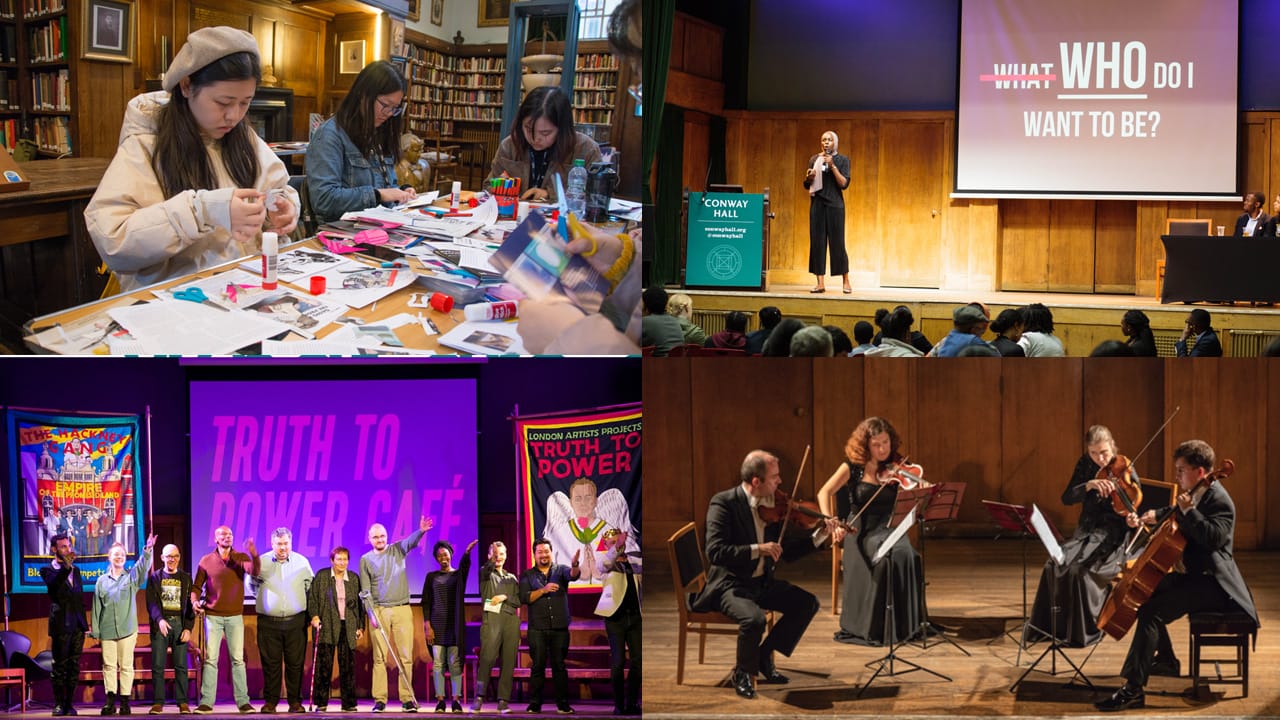
Today, the Society is an educational charity whose aims are the study and dissemination of ethical principles based on humanism and freethought, the cultivation of a rational and humane way of life, and the advancement of research and education in all relevant fields. In our premises, Conway Hall, we provide a range of activities open to all including lectures, debates, courses and a season of classical music concerts. We also have a Humanist Reference Library.
The Society is a member of the Humanist Liaison Group, along with the British Humanist Association, Camp Quest UK, the Council of Ex-Muslims of Britain, the Gay and Lesbian Humanist Association, the National Federation of Atheist, Humanist and Secular Student Societies, and the Rationalist Association.
The Society is also a member of the European Humanist Federation and the International Humanist and Ethical Union.
Other kindred organisations include the National Secular Society, the Thomas Paine Society, and the Freethought History Research Group.
To learn more about Humanism, please visit the new online guide The Really Simple Guide to Humanism.